Coalition Member Spotlight
37 Years of Building Literacy Success with Reading Assist
In September, Partnership for Student Success (PSS) Director of School and District Partnerships, Jen LoPiccolo, had a chance to interview Caroline O’Neal, the CEO of Reading Assist to learn more about their work and impact. Reading Assist is a PSS Supporting Champion organization that recruits, trains, and embeds tutors to support struggling readers across the Mid-Atlantic.
Jen LoPiccolo, PSS (JL): Tell us about the work of Reading Assist and how it aligns to the mission of the Partnership for Student Success to expand evidence-based and people-powered student supports?
Caroline O’Neal, Reading Assist (CO): For over 35 years, Reading Assist has recruited tutors and trained them in an accredited literacy curriculum aligned to the science of reading. We are deeply committed to high-impact tutoring. Currently, our tutors support struggling readers in Washington, D.C., Delaware, New Jersey, and Pennsylvania. We served about 2,300 students last school year, during the school day and after school, as well as in the summer. We work in early literacy, and one of the things we love about this work is that, while we might start the school year with many struggling readers, at the end of the year, those same students are asking for library cards, they’re reading to their grandma, and they’re so proud. Literacy is one of those beautifully solvable problems. Our curriculum is accredited, and our tutors spend a month in training, after which they have to pass competency exams and observations before they can begin working with students.
JL: Can you share a story or two that really captures Reading Assist’s impact on a student or tutor?
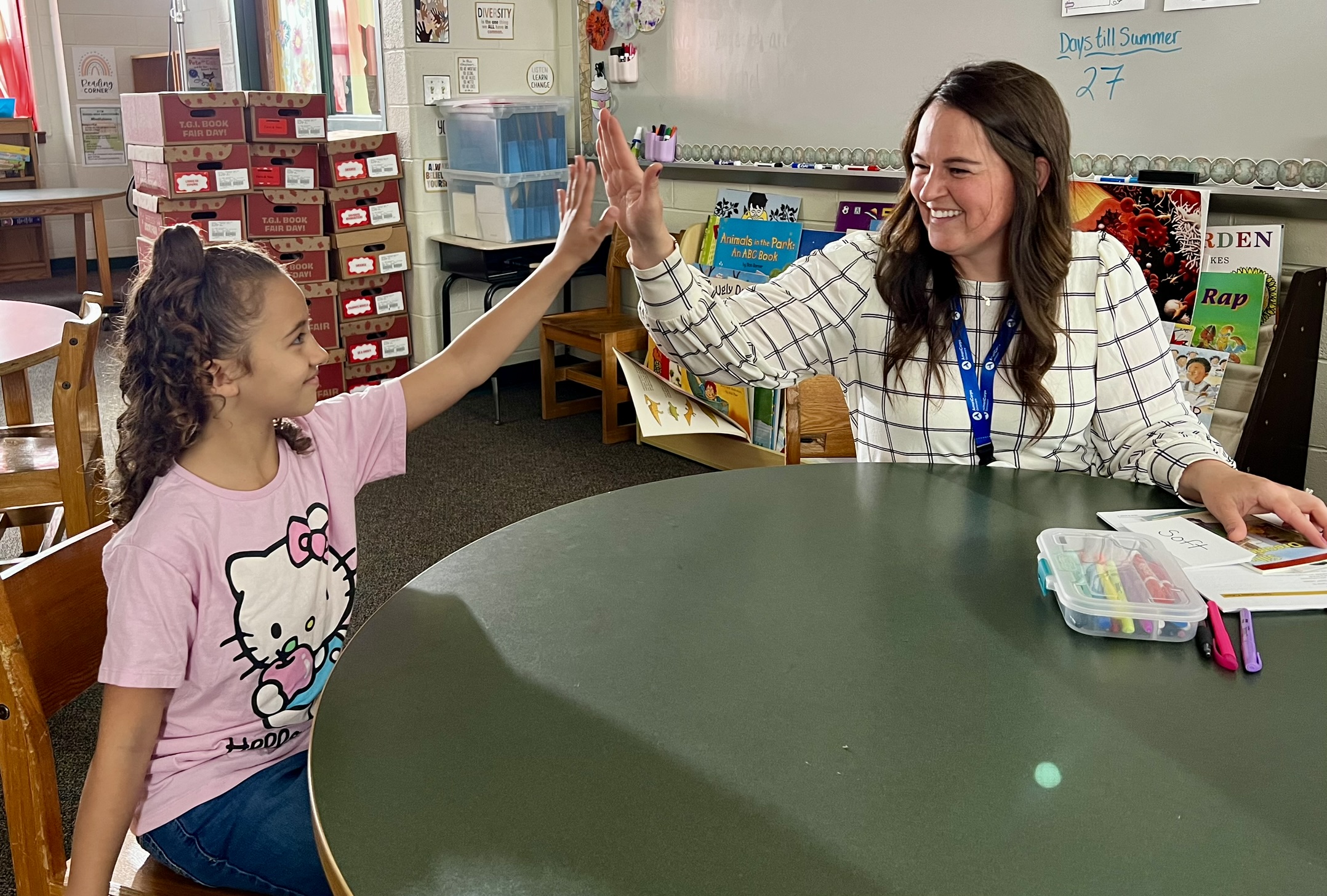
(CO): We’re working primarily with students in kindergarten through third grade, and we’ll frequently have a second or third grade student that will say, “Oh, I don’t know how to read,” and our tutors will say “That’s why I’m here. You’ve got me this year. You’re going to see me three to five days a week.” Students have an opportunity to read at every one of our lessons. One particular student who was working through their graphemes at the beginning of the year was reading with their tutor a few months later and stopped mid-sentence to say, “Am I reading? I think I’m reading. I’M READING!.” That “a-ha” moment when a kid realizes they can do this hard thing is a real privilege to be a part of and to see.
Also, through our PSS Community Collaboration Challenge award, we’ve expanded where and how we engage with students. While we traditionally support students during the school day in kindergarten through third grade, we also know there are many more students who need support, and we have to be flexible and be able to see students where they are. So, we have expanded our partnerships to community centers, and we recently started working with the YMCA in Delaware, embedding some of our trained tutors to work in their afterschool programming three to four days a week. We wondered whether students would be hesitant to have to do academic work after school, but when we checked in with our partners at the Y, their feedback was very positive. Tutors had built such positive relationships with the kids that on the days tutors weren’t on site, students were asking where tutors were and why they weren’t there!
Our number one priority is always student outcomes, and we have impact. Ninety percent of our students are reaching benchmark and foundational reading skills, and 84% of our kindergartners are testing on grade level. We love those results. That said, a close second priority are the outcomes that our tutors experience. We now have multiple pathways for our tutors to become teachers, which has been a great experience to be a part of. We get to see our tutors fall in love with teaching and have paths into the classroom. Reading Assist tutors are turning a service year into a profession.
JL: How has being part of the PSS Coalition supported your work?
(CO): We love the Partnership for Student Success because we deeply believe in the power of working with students and giving them not just what we have, but what they need to be successful. This really aligns with the mission of Reading Assist. We’ve seen the impact of that when we work with a student, when we provide them with a trained tutor who has an aligned evidence-based curriculum, and we can meet with that student frequently enough to see impact. We truly change their lives, and oftentimes change the lives of tutors as well. We have learned so much from the peer organizations that we’ve met, particularly at the PSS convening, which we’ve attended for multiple years. It’s one of the highlights of our year. We’ve learned how different models operate and where programs have had success. Being in a room with folks who are doing math tutoring has been super informative for us and has helped us expand our community partnerships. It has also helped us to expand how we think about higher ed partners and where we can engage in higher ed. We’re now really looking at Federal Work- Study and have been able to learn about it in a way that we would not have been able to learn without this community. There is a culture of openness in the share. Sometimes you go to conferences and people are bragging like, “Hey, look at all this cool stuff we’re doing,” which is great. But, I find that the conversations within PSS are also very vulnerable and open, and people will share what didn’t work or where they struggled, and you can ask the hard questions. They’re big enough that you have enough people in the room that have shared expertise, but they’re also small enough that you have access for real conversation.
JL: What advice would you offer organizations looking to strengthen or expand people-powered, evidence-based supports?
(CO): First of all, there is an incredible amount of resources out there in terms of high-impact tutoring research and evidence. So, if you’re trying to figure out what works, how to structure a program, there are tons of great tools available.
I think the other piece of advice is to make sure to balance non-negotiables. These should include an evidence-based curriculum, tutor requirements, and ongoing training and support. As nonprofits, there’s sometimes a pull to move quickly in response to a community need by providing help. But, you need to make sure that you’re providing high-quality, evidence-based support, and that that help is what is necessary. At the same time, you’ve got to be super flexible where you can be. For example, we have a curriculum, we have an assessment tool, we have training and materials, and we have a standard our tutors need to meet. At the same time, we can deliver it all in a summer program, an afterschool program at the YMCA, at a Boys and Girls Club, at an elementary school, etc. We need to flex as an organization to meet that shifting structure. Know where your guardrails are, but also make sure you’re being flexible enough, because at the end of the day, you’ve got to get to the kids that need you, wherever they are.
JL: And last, what is next for Reading Assist? Is there anything happening on the horizon that you would like to share?
(CO): We just wrapped up a really strong partnership this summer with United Way of Delaware, and in 2025, we won the Library of Congress Award, and the United Way of Delaware just won Library of Congress award this year, so it really feels like a double win for Reading Assist and for our work in Delaware.
We’re also really excited about the expansion work we’ve done in Pennsylvania. We’ve added some new school districts, and we are partnering with Read By 4th to think about how we best expand access to high-impact tutoring in Philadelphia, as we’ve done in Washington, DC. We will also have some impact results in a few months to share from an evaluation we are conducting with Johns Hopkins.
And I would be remiss if I didn’t share another pride point for us: We have recently graduated our 1st cohort of tutors to teachers. Through a partnership with Wilmington University, the cohort spent a year with us and then did a year-long classroom-based teacher residency.
***
Answers have been edited for brevity and clarity.

NEWSLETTER
Subscribe To Our Newsletter
Reference to any non-U.S. government organization, event or product does not constitute an endorsement, recommendation or favoring of that organization, event or product and is strictly for the information and convenience of the public.
This website is developed and maintained by the Everyone Graduates Center at Johns Hopkins University for the Partnership for Student Success.
It follows the website privacy policy found here. View the website's accessibility statement here.